
Import Duties & Tariffs for Commercial Furniture: 2026 Country-by-Country Guide
Introduction: The Hidden Cost in Every Imported Furniture Order
For B2B furniture buyers sourcing commercial furniture internationally, import duties and tariffs represent a significant — and often underestimated — component of total landed cost. Depending on the destination country, product classification, and applicable trade agreements, Tariffs vary by destination, product classification, origin, and current customs rules, so buyers should confirm the landed-cost calculation with a qualified customs broker.
- Introduction: The Hidden Cost in Every Imported Furniture Order
- Understanding HS Classification for Furniture
- Country-by-Country Tariff Schedule: 2026 Rates
- US Import Tariffs: Navigating Section 301
- European Union and United Kingdom: Zero MFN Duties but VAT Matters
- Middle East: GCC Harmonized Tariffs
- Singapore and Southeast Asia: Free Trade Advantages
- Australia and Canada
- Strategies for Minimizing Tariff Exposure
- Frequently Asked Questions
This 2026 country-by-country guide provides commercial furniture importers with current duty rates, preferential trade agreement options, classification guidance, and strategic approaches to minimizing tariff exposure across the world’s major furniture import markets.
Understanding HS Classification for Furniture
Before examining country-specific rates, it is essential to understand how furniture is classified for customs purposes. The Harmonized System (HS) assigns codes to all traded products. For commercial furniture, key HS chapters include:
- HS Chapter 94 (primary classification): Furniture and parts thereof.
- HS 9401: Seats and parts thereof.
- HS 9403: Other furniture and parts thereof, including office (9403.30), kitchen (9403.40), bedroom (9403.50), and other wood/metal/plastic furniture.
Correct classification is critical. Misclassification can result in duty reassessments, penalties, and customs audits. Professional customs brokers should review all classifications for multi-material products.
Country-by-Country Tariff Schedule: 2026 Rates
The following table presents current most-favored-nation (MFN) duty rates for wooden commercial furniture (HS 9403.30-9403.60) and metal commercial furniture (HS 9403.20) across major import markets.
| Country / Bloc | Wood Furniture Duty | Metal Furniture Duty | Preferential Options | VAT/GST |
|---|---|---|---|---|
| United States | 0% + 25% (301)* | 0% + 25% (301)* | USMCA (Mexico/Canada duty-free) | N/A (sales tax varies) |
| European Union | 0% (MFN) | 0% (MFN) | GSP (Vietnam, Indonesia, India) | 19-27% |
| United Kingdom | 0% (MFN) | 0% (MFN) | UK GSP (developing countries) | 20% |
| UAE | 5% | 5% | GCC unified tariff | 5% |
| Saudi Arabia | 5% | 5% | GCC unified tariff | 15% |
| Singapore | 0% | 0% | FTA network | 9% |
| Australia | 5% | 5% | ChAFTA, KAFTA, AANZFTA | 10% |
| Canada | 8% (MFN) | 6% (MFN) | USMCA, CPTPP | 5-13% |
| Japan | 0% (MFN) | 0% (MFN) | CPTPP, JP-EU EPA | 10% |
| South Korea | 0% (MFN) | 0% (MFN) | K-FTA, KR-EU FTA | 10% |
| India | 25% | 20% | Limited FTAs | 18% |
| Mexico | 15% | 15% | USMCA, CPTPP | 16% |
| Brazil | 18% | 18% | Mercosur | 17% |
*US Section 301 Tariffs: Wood and metal furniture originating in China remain subject to Section 301 tariffs of 25% on top of any applicable MFN duties.
US Import Tariffs: Navigating Section 301
The United States is the world’s largest furniture import market. Section 301 tariffs add 25% to the duty rate for most commercial furniture categories originating in China. Strategies for US importers include: verifying correct HTSUS classification, exploring alternative sourcing from Vietnam, Malaysia, or Mexico, utilizing Foreign Trade Zones to defer duty payments, and calculating total landed cost including customs brokerage fees, MPF (0.3464%), and HMF (0.125%).
European Union and United Kingdom: Zero MFN Duties but VAT Matters
Both the EU and UK apply 0% MFN duty rates to wooden and metal furniture. However, VAT rates on furniture range from 19% (Germany) to 27% (Hungary), with most major markets at 20-22%. The UK applies a flat 20% VAT. Buyers should factor VAT into landed cost and verify whether import VAT can be reclaimed.
Middle East: GCC Harmonized Tariffs
The GCC countries maintain a unified external tariff of 5% on most furniture imports. Saudi Arabia’s 15% VAT significantly increases total landed cost versus the UAE’s 5% VAT. Certification requirements in Saudi Arabia include SASO conformity assessment.
Singapore and Southeast Asia: Free Trade Advantages
Singapore is a zero-tariff destination for furniture imports with 9% GST. Other ASEAN markets present more challenging environments: Thailand applies 10-30% tariffs, Indonesia maintains protective tariffs, and the Philippines applies 10-15% duties.
Australia and Canada
Australia applies 5% MFN duty, but the China-Australia Free Trade Agreement (ChAFTA) has eliminated tariffs on Chinese-manufactured furniture. Canada applies MFN rates of 6-8%, with potential CPTPP preferences for furniture from Vietnam or Malaysia.
Strategies for Minimizing Tariff Exposure
- Correct Classification: Ensure products are classified under the most favorable applicable HS subheading.
- Trade Preference Utilization: Verify applicable free trade agreement or GSP program coverage.
- Component Sourcing: Consider importing furniture components (knock-down or flat-pack) which may qualify for different classification.
- Landed Cost Modeling: Develop comprehensive models including FOB price, freight, insurance, duties, taxes, and logistics fees.
Frequently Asked Questions
What is the difference between MFN duties and preferential duties?
MFN duties are standard WTO-negotiated rates applicable to all trading partners. Preferential duties are lower rates available under FTAs or GSP programs for qualifying products from specific origin countries.
How do I determine the correct HS code for my furniture product?
The primary classification is HS Chapter 94. Engage a licensed customs broker for definitive classification, particularly for multi-material products.
Are Section 301 tariffs still in effect on Chinese furniture imports to the US?
Yes, as of 2026, Section 301 tariffs of 25% remain in effect for most commercial furniture categories imported from China.
Which country has the lowest import duties on furniture?
Singapore (0% duty), the European Union (0% MFN), the United Kingdom (0% MFN), Japan (0% MFN), and South Korea (0% MFN) offer the lowest tariff rates.
How can I calculate total landed cost for furniture imports?
Total landed cost = FOB price + freight + insurance + customs duties + brokerage fees + VAT/GST + port handling + inland transportation.
What documentation is required for furniture customs clearance?
Standard documentation includes: commercial invoice, packing list, bill of lading, certificate of origin, HS classification documentation, and destination-specific certifications.
Can I import furniture samples without paying duties?
Many countries allow duty-free importation of commercial samples of negligible value. Larger samples may require temporary importation bonds or ATA Carnet documentation.
Related Products
 Booth Sofa | Commercial Restaurant & KTV Banquette Seating
 Dining Chair 02 | Commercial Restaurant & Hospitality Seating
 Dining Chair 01 | Commercial Restaurant & Hospitality Seating
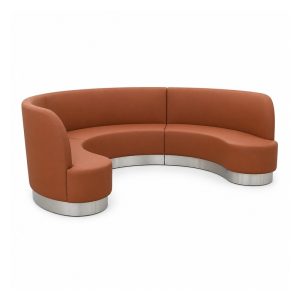 Half-Round Booth Sofa | Commercial KTV & Restaurant Banquette Seating
 Baka Dining Chair 0001 for Restaurant & Bistro
 Baka Lounge Chair 0032 for Hotel Lobby & Lounge
 Baka Lounge Chair 0031 for Office & Lounge
 Baka Lounge Chair 0030 for Lounge & Cafe